> For the complete documentation index, see [llms.txt](https://docs.bugsplat.com/llms.txt). Markdown versions of documentation pages are available by appending `.md` to page URLs; this page is available as [Markdown](https://docs.bugsplat.com/about/what-is-bugsplat.md).
# What is BugSplat?
BugSplat is the developer's go-to toolbox for finding, understanding, and fixing crashes.
BugSplat is the developer's go-to toolbox for finding, understanding, and fixing crashes. With BugSplat, developers know exactly which issues are causing their [end-users](/education/bugsplat-terminology.md#end-users) to experience crashes while using their product.
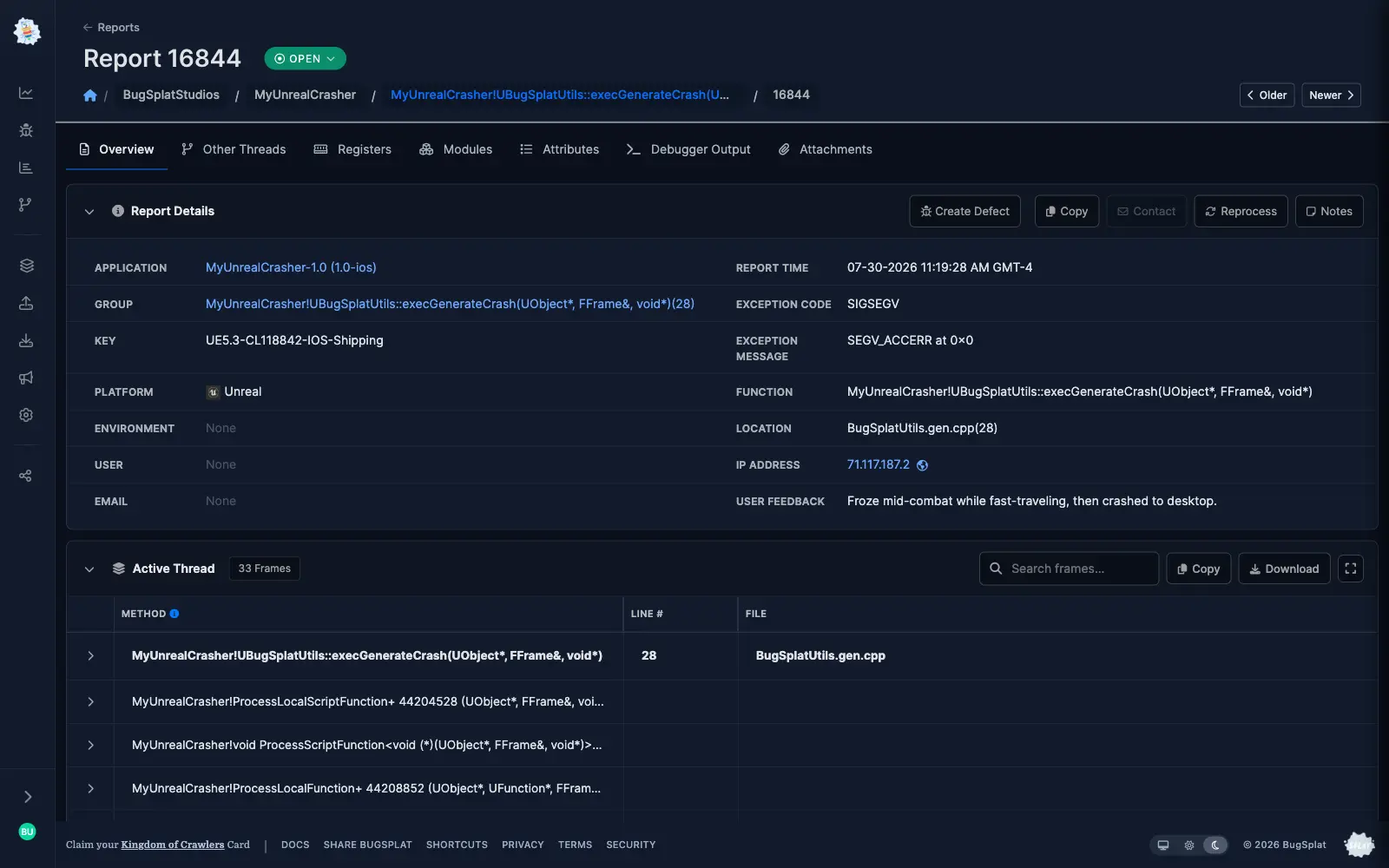
When a crash event occurs, BugSplat captures data critical for understanding the underlying defect. This data is presented in a familiar “debugger” view which allows developers to triage crashes as if the crash was captured locally on their own machine.
With BugSplat, developers can identify more issues during testing, monitor the quality of their shipped applications, and improve their workflow around development and support.
Overall, applications that use BugSplat are more stable, crash less often, and become cheaper and easier to support.
BugSplat is built on AWS’s scalable infrastructure which provides a secure and reliable service to developers and their end-users.
BugSplat supports all kinds of [platforms and languages ](/integrations/integrations.md)as well as [third-party tools integrations](/guides/integrating-with-tools.md).
If you're not sure if BugSplat is right for your application or game, please send us a note so we can understand your needs better!
* [Email us](mailto:hi@bugsplat.com)
* [Join our Discord](https://discord.gg/K4KjjRV5ve)
To get started with BugSplat, sign up for a free BugSplat account at .
---
# Agent Instructions
This documentation is published with GitBook. GitBook is the documentation platform designed so that both humans and AI agents can read, navigate, and reason over technical content effectively. Learn more at gitbook.com.
## Querying This Documentation
If you need additional information that is not directly available in this page, you can query the documentation by asking a question.
Perform an HTTP GET request on the following URL with the `ask` and `goal` query parameters:
```
GET https://docs.bugsplat.com/about/what-is-bugsplat.md?ask=&goal=
```
`ask` is the immediate question: it should be specific, self-contained, and written in natural language.
`goal` is what the user is ultimately trying to achieve, the reason they need the answer. Sharing it helps GitBook give you a better, more relevant answer. A goal is most helpful when it describes the outcome the user wants rather than restating the question. For example, with `ask=how do I create an API token`, a goal like `automate deployments from our CI pipeline` lets GitBook tailor the answer to that use case.
The response will contain a direct answer to the question and relevant excerpts and sources from the documentation.
Use this mechanism when the answer is not explicitly present in the current page, you need clarification or additional context, or you want to retrieve related documentation sections.