> For the complete documentation index, see [llms.txt](https://docs.bugsplat.com/llms.txt). Markdown versions of documentation pages are available by appending `.md` to page URLs; this page is available as [Markdown](https://docs.bugsplat.com/integrations/web/javascript.md).
# JavaScript
## 🧩 SPA Integrations
{% hint style="info" %}
BugSplat supports unwinding uglified and minified JavaScript stack traces via source maps. More information about configuring your application to upload source maps to BugSplat is available [here](/guides/working-with-symbol-files/source-maps.md).
{% endhint %}
BugSplat supports JavaScript and TypeScript error reporting in a variety of environments. We offer platform-specific integrations for [Angular](https://angular.dev/), [React](https://react.dev/), and [Node.js](https://nodejs.org/en) for your convenience.
Follow the links below for instructions on how to configure BugSplat in your application:
{% content-ref url="/pages/-MeQxcg-zqaGITt11RPi" %}
[Angular](/integrations/web/angular.md)
{% endcontent-ref %}
{% content-ref url="/pages/-Mg293QjQow3zAIW7VHg" %}
[React](/integrations/web/react.md)
{% endcontent-ref %}
{% content-ref url="/pages/-Mg296jB18ShFc9aUbC9" %}
[Vue](/integrations/web/vue.md)
{% endcontent-ref %}
{% content-ref url="/pages/-MeRTrBwNQFMT8JiWLql" %}
[Electron](/integrations/desktop/electron.md)
{% endcontent-ref %}
{% content-ref url="/pages/-MeRXRpKp3KQxkGy3IUU" %}
[Node.js](/integrations/web/node.js.md)
{% endcontent-ref %}
If a platform or framework your team is leveraging is not listed above, never fear! You can leverage our bugsplat [npm package](https://www.npmjs.com/package/bugsplat) to add error reporting to any browser-based app or [bugsplat-node](https://www.npmjs.com/package/bugsplat-node) to add error reporting to any Node.js based app.
## 🌐 Browsers
Using the browser directly is awesome! BugSplat fully supports applications that don't use SPA frameworks. Follow the directions below to integrate with bugsplat in a browser-based JavaScript application.
### ⚙️ Integrating
Import [bugsplat](https://github.com/BugSplat-Git/bugsplat-js) from [esm.sh](https://esm.sh/)
```html
```
Create a new instance of BugSplat with your database, application, and version
```javascript
const bugsplat = new BugSplat('fred', 'my-javascript-crasher', '1.0.0');
```
Configure bugsplat to listen to `window.onerror` and `window.onunhandledrejection` events
```javascript
window.onerror = function (message, source, lineno, colno, error) {
bugsplat.post(error);
};
window.addEventListener('unhandledrejection', function (event) {
bugsplat.post(event.reason);
});
```
Trigger an error to see it reported in BugSplat
```javascript
throw new Error('todo bg');
```
### 🔗 Error Chains (`cause`)
When you post an error that has a `cause` ([ES2022](https://developer.mozilla.org/en-US/docs/Web/JavaScript/Reference/Global_Objects/Error/cause)) or an `AggregateError` with `errors`, bugsplat walks the chain (up to 100 linked errors) and sends the whole chain as the crash report. For each error, bugsplat records its type (`name`), message, stack, and its own enumerable properties, such as a Postgres error's `code`, `constraint_name`, and `detail`, or a Node.js system error's `code`, `errno`, and `syscall`. There is nothing to configure.
Wrap a low-level error and rethrow it; the `window.onerror` handler above posts the wrapper, and bugsplat captures the cause along with it
```javascript
try {
saveRecord(record);
} catch (err) {
throw new Error('Failed to save', { cause: err });
}
```
On the Crash page, the callstack starts with the frames of the error you posted. Each linked error follows as a `Caused by: ` row and then its own stack frames. Its message and properties are shown as that row's locals (toggle arguments and locals to see them). Properties of the error you posted, such as a request ID you attach before rethrowing, are added to the crash's attributes; attributes you pass to `post()` take precedence. The crash's Exception Code and Exception Message come from the innermost error, so a wrapper like `Error: Failed to save` no longer hides `PostgresError: duplicate key value violates unique constraint "idx_records_email"`.
Grouping is unchanged: BugSplat still keys crashes on the function name and line number of the error you posted. A linked error's message is never part of a group's name, so causes that differ only in their message, such as a different address or ID, group together. If an auto-grouping rule ignores every frame of the error you posted, such as frames from `node_modules`, grouping continues into the linked errors' stacks and skips the `Caused by:` rows. If the error you posted has no stack, its first `Caused by: ` row becomes the key.
{% hint style="info" %}
Error chain capture requires `bugsplat` 9.2.0 or newer.
{% endhint %}
### 💬 User Feedback
In addition to crash reporting, BugSplat supports collecting non-crashing user feedback such as bug reports and feature requests. Feedback reports appear in BugSplat with the "User Feedback" type, grouped by title.
```javascript
await bugsplat.postFeedback('Login button broken', {
description: 'Nothing happens when I tap it',
email: 'jane@example.com',
});
```
You can also attach files such as screenshots:
```javascript
const screenshot = document.querySelector('input[type="file"]').files[0];
await bugsplat.postFeedback('UI rendering issue', {
description: 'The sidebar overlaps the main content.',
attachments: [
{ filename: 'screenshot.png', data: screenshot },
],
});
```
### 🧪 Sample
Clone the [my-javascript-crasher](https://github.com/BugSplat-Git/my-javascript-crasher) repository
```sh
git clone https://github.com/BugSplat-Git/my-javascript-crasher
```
Install the dependencies
```sh
cd my-javascript-crasher
npm i
```
Start the server
```shell
npm start
```
Open your browser and navigate to [http://localhost:8080](http://localhost:8080/), then click the button to trigger an error.
### 📈 Viewing Reports
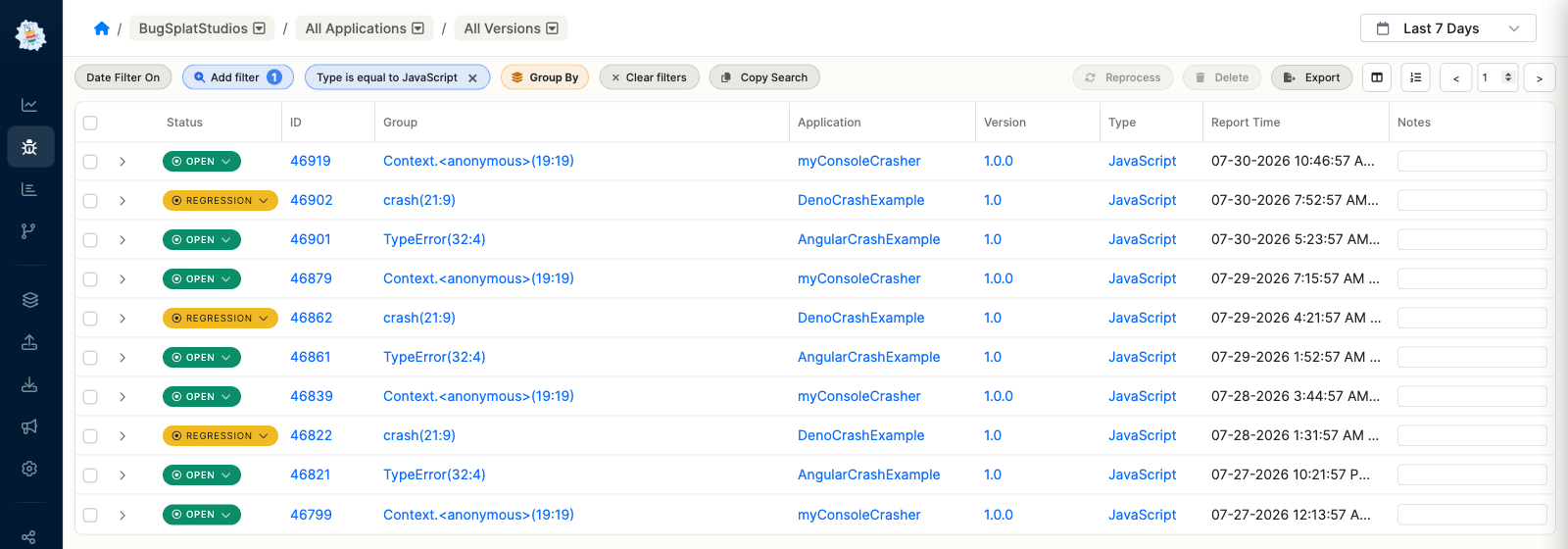
Navigate to the BugSplat [Crashes](https://app.bugsplat.com/v2/crashes?database=Fred\&c0=appName\&f0=CONTAINS\&v0=my-javascript-crasher) page to view your report
BugSplat Crashes Page
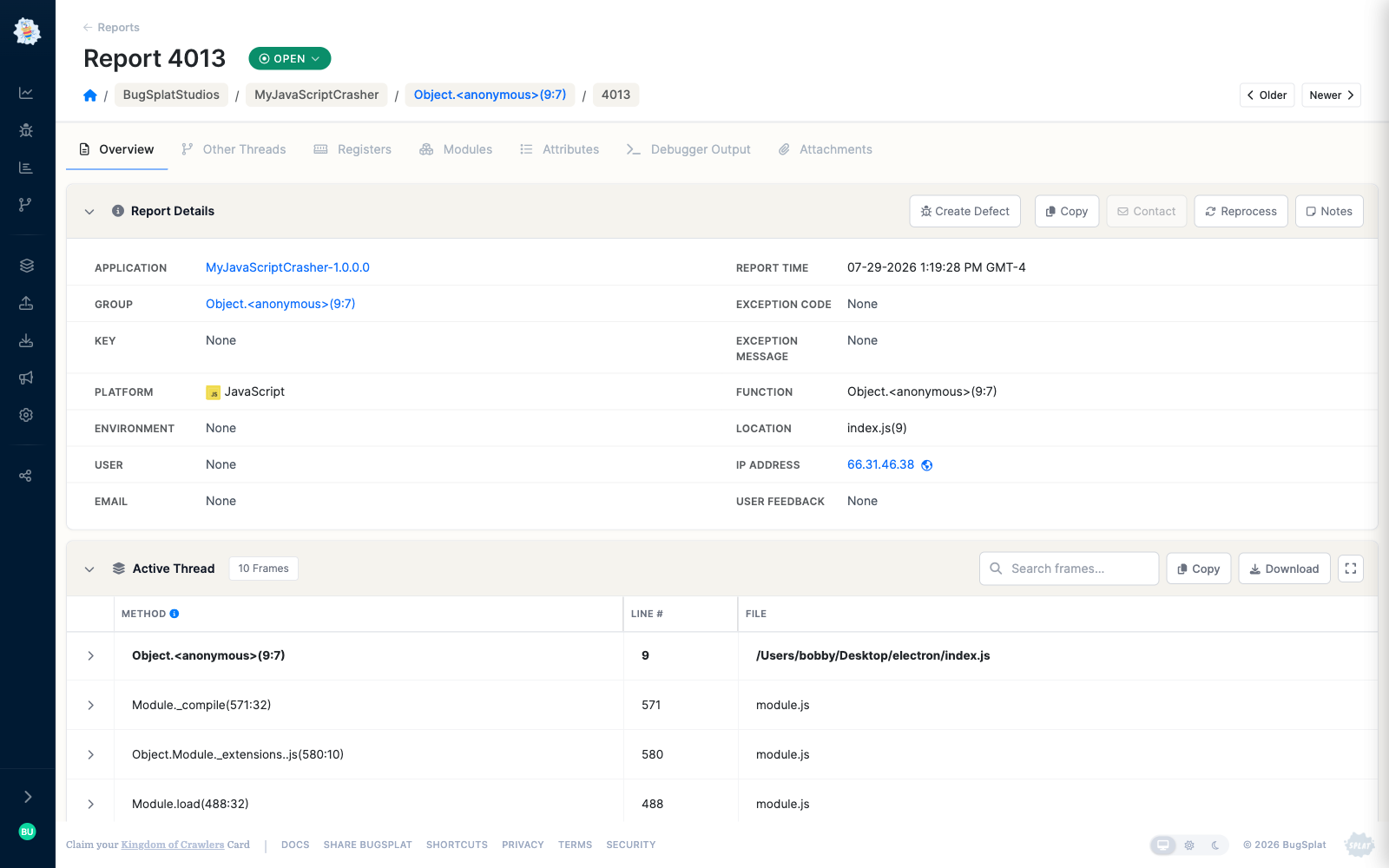
Click on the ID of the most recent error to view the details of your report
BugSplat Crash Page
---
# Agent Instructions
This documentation is published with GitBook. GitBook is the documentation platform designed so that both humans and AI agents can read, navigate, and reason over technical content effectively. Learn more at gitbook.com.
## Querying This Documentation
If you need additional information that is not directly available in this page, you can query the documentation by asking a question.
Perform an HTTP GET request on the following URL with the `ask` and `goal` query parameters:
```
GET https://docs.bugsplat.com/integrations/web/javascript.md?ask=&goal=
```
`ask` is the immediate question: it should be specific, self-contained, and written in natural language.
`goal` is what the user is ultimately trying to achieve, the reason they need the answer. Sharing it helps GitBook give you a better, more relevant answer. A goal is most helpful when it describes the outcome the user wants rather than restating the question. For example, with `ask=how do I create an API token`, a goal like `automate deployments from our CI pipeline` lets GitBook tailor the answer to that use case.
The response will contain a direct answer to the question and relevant excerpts and sources from the documentation.
Use this mechanism when the answer is not explicitly present in the current page, you need clarification or additional context, or you want to retrieve related documentation sections.