> For the complete documentation index, see [llms.txt](https://docs.bugsplat.com/llms.txt). Markdown versions of documentation pages are available by appending `.md` to page URLs; this page is available as [Markdown](https://docs.bugsplat.com/education/how-tos/using-the-crash-attribute-feature.md).
# Using the Crash Attribute Feature
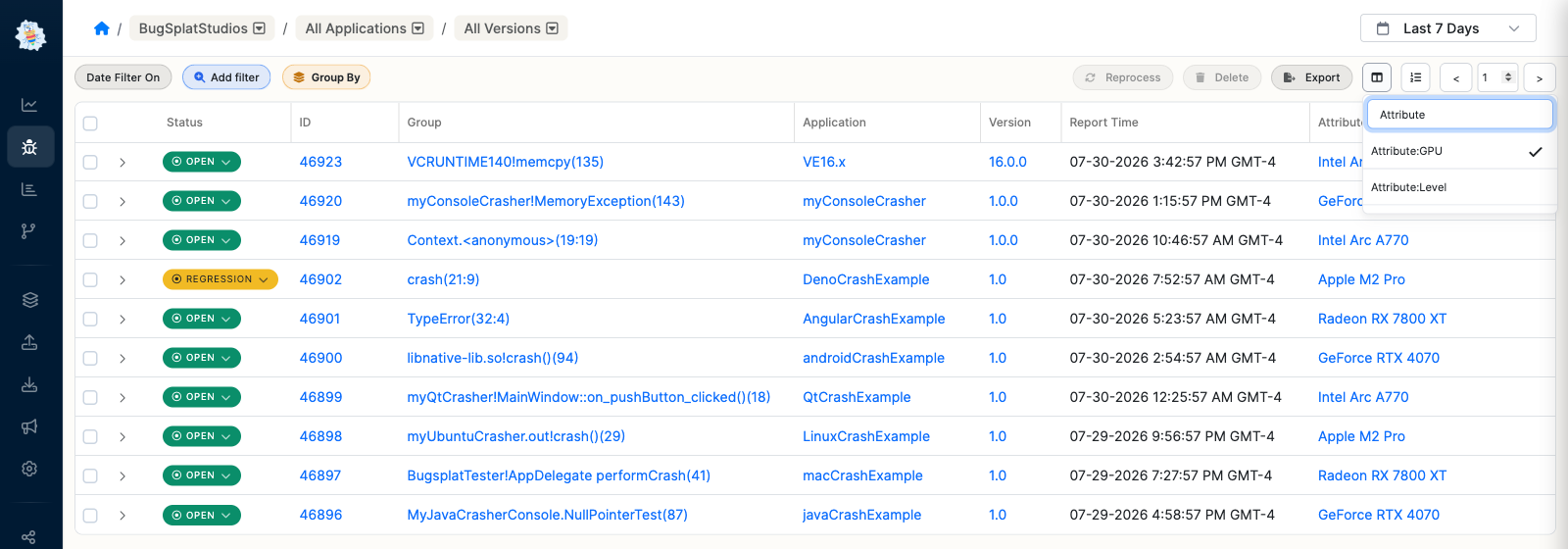
BugSplat supports user-defined metadata, also known as Custom Crash Attributes, in crash and error reports**.** These attributes are composed of name-value pairs that can be seamlessly integrated into your application's crash reporting setup. Each custom attribute can be displayed as a column on the crashes page, with all attributes accessible on the crash detail pages.
**Features:**
* **Display and Visibility:** Custom attributes can be viewed as columns on the crash report page, and are fully accessible on the crash detail pages.
* **Search, Group, Sort:** Custom attributes can be used in search, sorting, and grouping operations, just like other column values.
**Implementation:**
* Custom Crash Attributes are supported on all BugSplat crash platforms
* For **Windows** and **Xbox**, refer to the [BugSplat for Windows C++ documentation](/integrations/desktop/cplusplus.md);
* For **PlayStation**, please refer to the documentation in the download found on the [Gaming Consoles](https://app.bugsplat.com/v2/database/integrations#consoles) tab on the Integrations page.
* For **Apple** platforms, refer to the [macOS](/integrations/desktop/macos.md)/[iOS](/integrations/mobile/ios.md#attributes) documentation.
* For **Linux**, **Crashpad**, **Qt**, **CMake**, and **Android,** BugSplat parses annotations as attributes. See the [Crashpad documentation](/integrations/desktop/crashpad.md#initialization) for more info on how to add annotations.
## Reserved Attribute Names
A few attribute names are reserved. When a crash report includes an attribute with one of these names, BugSplat uses its value to set the corresponding first-class crash field instead of displaying it as a regular attribute. Reserved names work from any platform that sends attributes.
| Attribute Name | Crash Field |
| ---------------------- | ----------- |
| BugSplatUser | User |
| BugSplatEmail | Email |
| BugSplatApplicationKey | Key |
| BugSplatNotes | Notes |
| BugSplatDescription | Description |
For any issues or inquiries, please reach out to us at . Our team is dedicated to helping you optimize your BugSplat integration and ensuring your application's crash reporting performs seamlessly.
---
# Agent Instructions
This documentation is published with GitBook. GitBook is the documentation platform designed so that both humans and AI agents can read, navigate, and reason over technical content effectively. Learn more at gitbook.com.
## Querying This Documentation
If you need additional information that is not directly available in this page, you can query the documentation by asking a question.
Perform an HTTP GET request on the following URL with the `ask` and `goal` query parameters:
```
GET https://docs.bugsplat.com/education/how-tos/using-the-crash-attribute-feature.md?ask=&goal=
```
`ask` is the immediate question: it should be specific, self-contained, and written in natural language.
`goal` is what the user is ultimately trying to achieve, the reason they need the answer. Sharing it helps GitBook give you a better, more relevant answer. A goal is most helpful when it describes the outcome the user wants rather than restating the question. For example, with `ask=how do I create an API token`, a goal like `automate deployments from our CI pipeline` lets GitBook tailor the answer to that use case.
The response will contain a direct answer to the question and relevant excerpts and sources from the documentation.
Use this mechanism when the answer is not explicitly present in the current page, you need clarification or additional context, or you want to retrieve related documentation sections.